Robots and cobots in production and the state of their application in Poland
Robots and cobots are becoming an essential part of industry transformation. Production automation is ceasing to be a mere technological trend, and is increasingly becoming a strategic direction for companies. In order to properly assess the potential of these solutions, it is worth sorting out the basic definitions, looking at current statistics and seeing how Poland compares to the global robotization market.
The following article is based on data and analysis of robot and cobot applications in industry.
What are robots and cobots and what are the most important differences between them
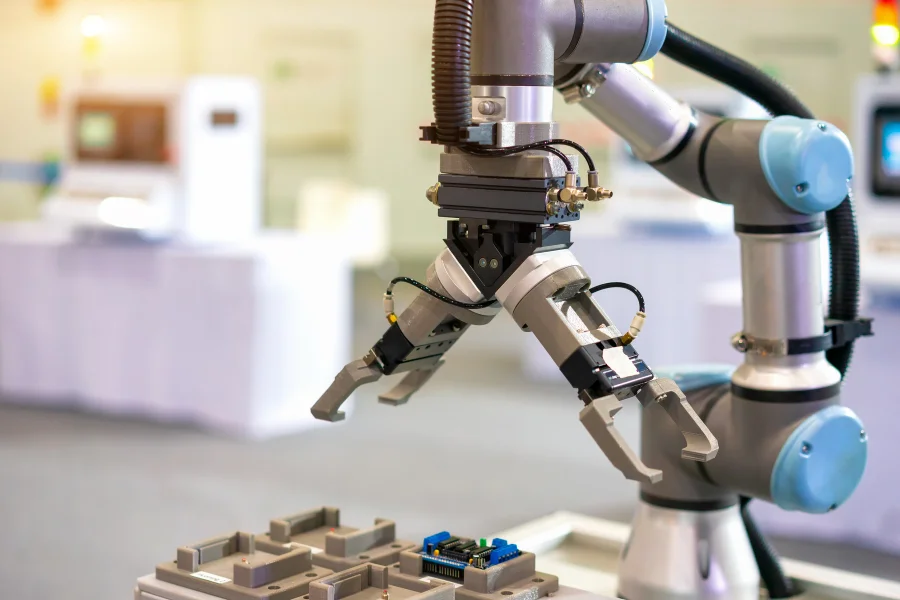
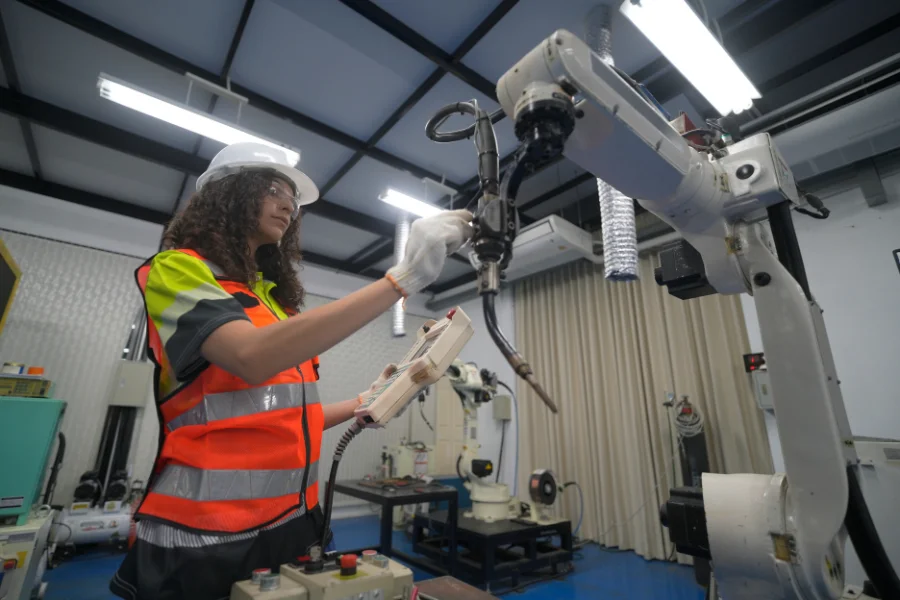
An industrial robot is a device that carries out the production process automatically and autonomously. Most often, it works in a separate safety zone, and its main purpose is to increase the efficiency and safety of the implemented operations, as well as to take over repetitive tasks.
A cobot, or collaborative robot, is designed to work alongside humans. It is typically characterized by slower movement and less technical features, allowing it to take over selected tasks without fully separating the workstation.
Robots are more often responsible for fully automating the process, while cobots support operators and complement their activities.
Get 5 chapters of the book for free!
Join the newsletter and gain access to 40% of the book “15 Steps to Buying an Information System“.
Most common applications of robots and cobots in manufacturing
Although the development of robotic technology covers many areas, data from the industrial market shows a clear dominance of specific types of applications.
The largest share is:
material handling and manipulation – about 52% of applications, involving feeding, transporting and stacking products,
It follows that robots and cobots are primarily used in repetitive tasks that require physical strength or high precision.
Robotization in Poland – current data
According to data for 2024, there are about 26,000 industrial robots in operation in Poland.
While this number may seem significant, in relation to the size of the economy and the country’s population, the level of robotization remains relatively low. In addition, a decline in deployment dynamics is observed:
13% fewer robotic applications were installed 2024 than in 2023,
These figures indicate that the Polish market for robots and cobots is still in the development stage and has great potential for growth.
Poland’s position in the global robot market
One of the most widely used benchmarks is the number of robots per 10,000 industrial workers. This is a metric that allows you to assess the actual level of automation in manufacturing.
Against the backdrop of technology leaders in the CEE region, Poland performs relatively poorly, which shows the scale of the challenges of industrial transformation.
Lower levels of robotization can affect productivity, production costs and the ability of companies to compete in international markets.
Robots and cobots vs. return on investment
Initially, robotization was seen mainly as a way to replace human labor. Return on investment was calculated primarily on the basis of increased productivity and increased production volume.
Today, this approach is evolving. Robots and cobots are increasingly playing the role of tools for stabilizing production processes, improving quality and enhancing work safety.
Development directions – what lies ahead for robots and cobots?
Robots equipped with artificial intelligence are being developed around the world to take on increasingly complex tasks. This is the next stage in the development of robotization, although currently most deployments are still focused on classic industrial applications.
From the perspective of manufacturing plants, this means that the coming years will be a period of parallel development of both industrial robots and cobots to support the work of operators.
Robots and cobots in manufacturing will play an increasingly important role
Robots and cobots are becoming an integral part of modern manufacturing. Market data show that their use is mainly focused on repetitive processes, and the level of robotization in Poland is still lower than in the most technologically developed countries.
At the same time, increasing competitive pressures and the need to increase production efficiency indicate that automation using robots and cobots will be one of the key directions of industry development in the coming years.
FAQ – frequently asked questions about robots and cobots
Can a cobot completely replace an industrial robot?
Not always. Cobots are designed mainly for human collaboration and usually have lower technical performance. In many applications requiring high performance or fully autonomous operation, classic industrial robots are better suited.
Why is handling the most popular application of robots?
Handling involves repetitive and physically demanding tasks, such as moving or stacking products. According to market data, it accounts for about 52% of robotic applications, since it is in these processes that automation brings the greatest efficiency gains.
How many industrial robots are currently in operation in Poland?
It is estimated that in 2024 there will be about 26,000 industrial robots in operation in Poland. However, compared to market leaders, the level of robotization remains relatively low.
Is the pace of robotization in Poland increasing?
The data shows that in 2024, the number of new installations fell by about 13% from the previous year, even though the record level of deployments was reached in 2021.
Do robots and cobots mean job cuts?
Not always. Increasingly, they are being used as tools to support workers, improve safety and stability of production processes, rather than solely as a replacement.
Check Out New Episode of Digitalizuj.pl Podcast
Are we at risk of losing jobs to AI, robots and cobots? What’s the state of robotization in Poland? Listen to the latest episode od the podcast and find out.
Watch the video
Wondering how robots and cobots can change your facility for the better? Leave a message and let's talk about solutions.
To provide the best experiences, we use technologies like cookies to store and/or access device information. Consenting to these technologies will allow us to process data such as browsing behavior or unique IDs on this site. Not consenting or withdrawing consent, may adversely affect certain features and functions.
Functional
Always active
The technical storage or access is strictly necessary for the legitimate purpose of enabling the use of a specific service explicitly requested by the subscriber or user, or for the sole purpose of carrying out the transmission of a communication over an electronic communications network.
Preferencje
Przechowywanie lub dostęp techniczny jest niezbędny do uzasadnionego celu przechowywania preferencji, o które nie prosi subskrybent lub użytkownik.
Statistics
The technical storage or access that is used exclusively for statistical purposes.Przechowywanie techniczne lub dostęp, który jest używany wyłącznie do anonimowych celów statystycznych. Bez wezwania do sądu, dobrowolnego podporządkowania się dostawcy usług internetowych lub dodatkowych zapisów od strony trzeciej, informacje przechowywane lub pobierane wyłącznie w tym celu zwykle nie mogą być wykorzystywane do identyfikacji użytkownika.
Marketing
Przechowywanie lub dostęp techniczny jest wymagany do tworzenia profili użytkowników w celu wysyłania reklam lub śledzenia użytkownika na stronie internetowej lub na kilku stronach internetowych w podobnych celach marketingowych.