Industry 4.0: the Challenges of Modern Manufacturing
That is why Industry 4.0 is more than a popular buzzword. It is a structured way to bring production, maintenance, quality, and planning together in one data environment. When information from machines, systems, and people starts to connect, it becomes easier to reduce downtime, cut waste, and respond faster when something starts to drift.
For many manufacturers, moving in this direction is now the obvious choice. The real question is how to do it without confusion, wasted budget, or another disconnected system that runs next to everything else.
What Industry 4.0 Really Means Today
Industry 4.0 means data-based manufacturing built on integration and automatic information flow. Machines stop operating as isolated assets and become part of a wider setup where the process matters, but the data created along the way matters too, especially how quickly it can be used.
This usually brings together several layers:
- production machines and lines,
- sensors and data collection systems,
- MES, ERP, CMMS, WMS, and SCADA platforms,
- analytics, reporting, and automatic alerts,
- security rules, access control, and change management.
This matters because automation on its own does not solve the problem. A plant can have modern equipment and still have no clear answer to where quality losses come from, why micro-stoppages are increasing, or why the production plan does not match actual output.
The Core of Industry 4.0 in Manufacturing
If you had to define the core of Industry 4.0 in one sentence, it would be this: turning scattered information into decisions made at the right time.
That is what separates mature projects from expensive experiments. The point is not to add more screens, dashboards, or devices. The point is to:
- see production status as close to real time as possible,
- connect technical data with business data,
- spot deviations before they become bigger problems,
- plan faster and report performance more accurately,
- reduce decisions based only on instinct.
This is where the value becomes visible. Management does not need to wait until the end of the shift, day, or week to realize that a process is starting to slip. Maintenance teams do not have to work only in reaction mode. Quality teams can spot warning signs earlier instead of checking only the final result.
Industry 4.0: the Challenges of Modern Manufacturing
This phrase captures the scale of change well. The issue is not only technology. The real difficulty starts when a company has to connect equipment, people, processes, and responsibility for data.
1. Data exists everywhere, but it is hard to use
Information often sits in several places at once. Some of it goes into ERP, some into Excel, some stays inside controllers, and some remains in operator notes. That slows down response time and makes it harder to assess what is really happening.
When someone asks about OEE, downtime causes, material consumption, or maintenance history, the answer often depends on manually combining data from several sources. That takes time and creates errors.
2. Older systems must work with newer tools
A manufacturing site rarely starts from zero. It already has machinery, ERP, local applications, internal reports, and routines built over many years. The challenge is to connect new technology with infrastructure that was never designed to work as one system.
This is one of the main reasons projects drag on or fail to deliver the full result. Technology has to fit the reality of the plant, not the other way around.
3. No shared data model
What production calls downtime may not mean the same thing to planning, quality, or finance. When definitions differ, reports differ too. Then every meeting starts with an argument about numbers instead of a decision.
Without a shared data model, it is hard to build a reliable picture of performance. It is also hard to trust a system that shows one thing one day and something else the next.
4. Cybersecurity in OT and IT environments
The more connected the plant becomes, the larger the risk surface. This applies to new systems and also to older equipment that was not built for current security requirements.
That means manufacturers need network separation, access control, segmentation, event monitoring, and consistent rules across IT and OT. Without that, even a well-planned digitalisation project can create new problems.
5. Resistance inside the organisation and change fatigue
Not every problem can be fixed by buying software. Some problems come from team concerns about control, extra tasks, a new way of working, or losing influence over the process.
If a project does not show people the point and the benefit, resistance appears. Then even a good system works only in part. Data is entered selectively, procedures are bypassed, and reports become a formality.
6. Difficulty calculating ROI
Many boards are asking the right question: how much will this deliver, and when? Some effects are easy to calculate, but others do not show up in a spreadsheet straight away.
Simple indicators include fewer stoppages, less scrap, higher line efficiency, lower energy use, and faster changeovers. Harder-to-measure effects include better predictability, stronger planning, less friction between departments, and faster risk detection.
Still, these are often the factors that decide whether a company runs with control or spends its time putting out fires.
<div class=”textarea_pp”>
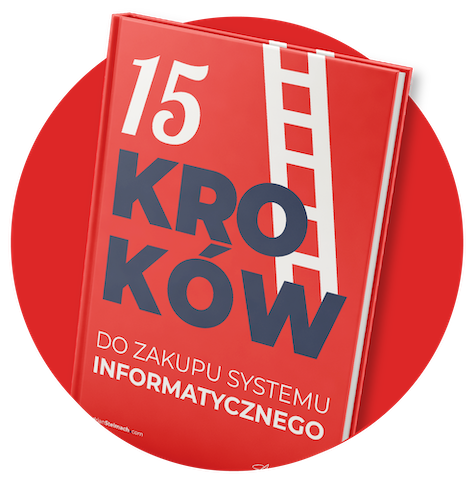
<p style=”font-size: 28px;”><b>Get 5 chapters of the book for free!<b></b></b></p>
<p style=”font-weight: 400;”>Join the newsletter and gain access to 40% of the book
<em><strong>”</strong><strong>15 Steps to Buying an Information System</strong><strong>”</strong></em><strong>.</strong></p>
</div>
<!– wp:spacer {“height”:”50px”} –>
<div class=”wp-block-spacer” aria-hidden=”true”></div>
Industry 4.0 Features That Make a Real Difference
It helps to separate theory from what matters on the plant floor. Not every list of Industry 4.0 features will matter to a manufacturer that wants better control and better results.
The features that usually matter most are:
Data integration across multiple sources
A system only makes sense when it collects data from machines, lines, sensors, business systems, and operator input into one model. Without that, the picture stays incomplete.
Process visibility close to real time
This is not only for live monitoring. It is also about faster response. When a deviation is visible immediately, losses can be limited before they grow.
Automatic information flow
Manual data entry slows work down and adds mistakes. In a mature manufacturing environment, some information moves automatically between systems and can trigger the next action.
Analytics and event prediction
Historical data is more than an archive. It can help predict failures, assess process consistency, identify sources of loss, and plan maintenance work.
Production flexibility
The market changes faster than before. Batches are shorter, variants are more common, and time pressure is stronger. Production needs better coordination between planning, resources, and actual execution.
Data security and business continuity
Digitalisation without security creates risk, not advantage. Access protection, network segmentation, and change control are now basic requirements.
Machines in Industry 4.0 Are More Than Execution Tools
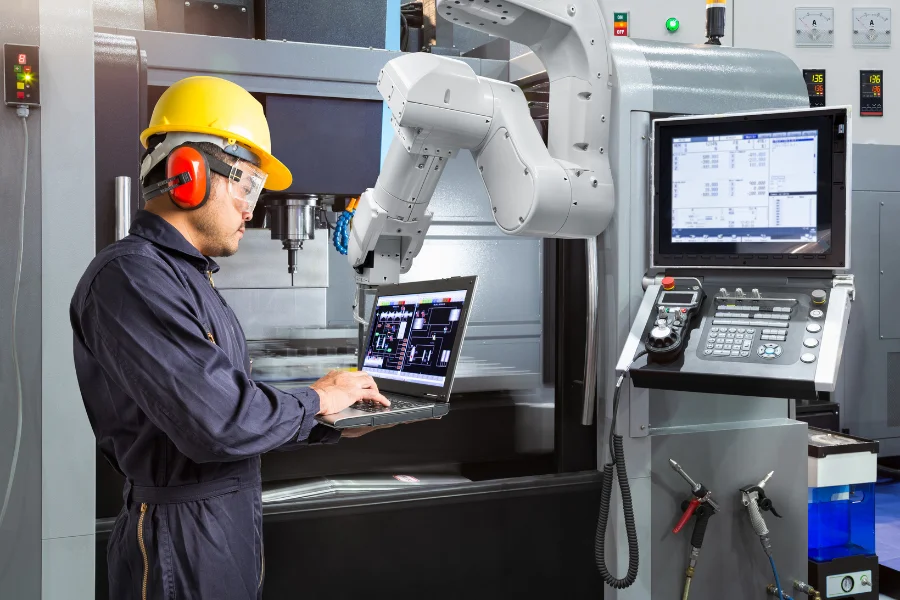
Machines in Industry 4.0 should be viewed as more than equipment used to perform an operation. A machine is also a source of data, signals, and insight into process conditions. That changes a lot.
When a machine sends information about cycle time, temperature, vibration, component wear, alarms, and downtime, it becomes easier to:
- predict failures,
- plan maintenance,
- compare line performance,
- detect quality decline,
- analyse loss causes.
This shifts the company away from reacting after the fact and toward acting earlier. There is no need to wait for a breakdown to see that something is wrong. There is also less need to rely only on operator statements when real process data is available.
At the same time, not every machine needs to be replaced with a new one. In many cases, better results come from gradually adding a data collection layer, integration, and clear reporting logic to existing assets. This matters most in plants with mixed equipment from different years and suppliers.
Where Industry 4.0 Projects Usually Lose Momentum
Projects rarely stop at the point of buying software. They tend to slow down later, when it becomes clear that the company did not define the basics first.
The most common reasons are:
Starting too wide
Trying to cover the entire plant at once increases risk. Better results often come from starting with one area where the outcome can be seen clearly. That could be a line, a cell, a quality process, or maintenance.
No business owner
If the project belongs only to the system team, it loses direction quickly. There needs to be a business-side owner who understands why the company is doing it and what decisions should improve as a result.
Collecting data without a use plan
Data on its own has no value. The company needs to know which indicators matter, who uses them, and what actions should follow from them.
Ignoring the operational layer
If operators, shift leaders, planners, and maintenance staff do not see the value in the new way of working, the system will only perform well in presentations. On the shop floor, parallel habits will continue and data quality will fall.
How to Approach an Industry 4.0 Implementation and See Results
A good implementation does not start with the question, which system should we buy? It starts with a different question: which production problem hurts the most, and can we measure it?
A sensible order looks like this:
1. Set a business goal
Not digitalisation for its own sake, but a clear result. For example, fewer stoppages, better production data quality, faster response to breakdowns, or more reliable planning.
2. Check the data sources
Find out where data comes from, who enters it, where it becomes inconsistent, and what is missing today. Only then should integration be designed.
3. Choose a pilot area
Pick an area where the problem is visible and the result can be checked quickly. That reduces risk and helps build support for later stages.
4. Agree on shared definitions
Downtime, scrap, output, alarm, plan, actual result. If every team understands these terms differently, no report will be reliable. Everyone needs the same meaning for each one.
5. Bring IT, OT, and business together
Without all three, the project will stay incomplete. One side knows the systems, another knows the machines, and the third knows which results matter to the company.
6. Measure results from the start
Do not wait until the end of the project. Track results from the first stage so it is clear whether the chosen direction is improving performance.
What a Well-Structured Industry 4.0 Project Gives You
When the project is planned properly, the effects are visible in more than reports. They appear in daily work. Less uncertainty. Less manual checking. Fewer conversations based on assumptions.
- faster response to disruptions,
- better production predictability,
- stronger cooperation between departments,
- better data quality,
- fewer late decisions,
- calmer planning of investments and changes.
This also matters for the day-to-day atmosphere in the plant. When the process is easier to read, pressure drops. People do not have to work under constant strain from solving the same problems again and again. It becomes easier to regain control over production.
Industry 4.0 Is Not a One-Time Project
Once you look at the subject properly, one thing becomes clear: Industry 4.0 does not end when a system goes live. It is a way of managing manufacturing that depends on clean data, process discipline, and regular review of what works and what needs improvement.
There is no need to do everything at once. It is better to start where the problem is costly and easy to see. From there, the scope can expand to more lines, more areas, and more use cases.
That is when technology starts working for the company’s performance instead of only adding more screens and reports.
FAQ
What is Industry 4.0?
Industry 4.0 is a manufacturing model where machines, systems, and people work from shared data. The goal is better process control, faster decisions, and less waste.
What is the core idea behind Industry 4.0?
The core idea of Industry 4.0 is to connect data from many sources and use it to make decisions on time, not only after a problem has already happened.
What are the most important Industry 4.0 features?
The most important features are data integration, process visibility, automatic information flow, analytics, production flexibility, and security across IT and OT environments.
What role do machines play in Industry 4.0?
Machines in Industry 4.0 do more than perform operations. They also provide data about process conditions, which helps reduce downtime, improve quality, and plan maintenance more accurately.
Does Industry 4.0 require replacing the entire machine park?
No. In many cases, companies can start by integrating existing equipment, adding data collection, and connecting machines to higher-level systems.
Where should a company start with Industry 4.0?
The best place to start is with one measurable business problem, one pilot area, and one shared data model. That makes it easier to assess the result and reduce risk.