Food Traceability in Manufacturing: Reduce Risk and Act Faster
When something goes wrong in production, food traceability quickly moves from a background topic to a business problem.
A customer complaint comes in. A quality issue appears. A raw material lot raises concerns. An auditor asks for the full history of a batch.
That is when you find out whether your plant has real control over product flow or just a large number of records stored in different places.
In food manufacturing, having data is not enough. You need to find the right records fast, connect them correctly, and make decisions without slowing down production more than necessary.
Done well, food traceability helps you reduce risk, shorten investigations, prepare for audits, and limit the scale of recalls or internal product holds.
What is food traceability?
Food traceability is the ability to track and verify where a food product came from, what happened to it during production, and where it went afterward.
At a basic level, that means being able to confirm:
where a raw material came from
which batch it belonged to
how it moved through production
which finished products it was used in
where those finished products were stored or shipped
In a real food plant, that usually involves much more than raw material receipt and finished goods dispatch.
Good food traceability should connect:
raw material lots and ingredients
semi-finished products
recipes and production orders
process parameters
production times and key events
lines, machines, and operators
quality inspections and deviations
warehouse records and shipment data
The goal is simple: you should be able to reconstruct the full history of a batch inside your plant without manually piecing information together from multiple sources.
Why food traceability becomes difficult in daily operations
In many plants, the data already exists. The problem is that it is spread across too many places.
You may have information in:
ERP or MES systems
shift reports
machine printouts
spreadsheets
quality forms
warehouse documents
On paper, that sounds manageable. In practice, it often means your team has to search through several records before they can answer one urgent question.
That is where weak food traceability starts to hurt operations.
You feel it most when you need to know:
which raw material lot was used in a product
which other batches are linked to the same issue
which products are at risk
what should be blocked
what can safely stay in production or shipping
If those answers take hours, the issue is no longer just documentation. It becomes a response-time problem.
When manual food traceability stops working
Manual systems often seem good enough until the first serious issue tests them.
A few spreadsheets, paper records, quality forms, and operator notes can work for routine reporting. They usually stop working well when speed and accuracy matter at the same time.
That often happens when:
a customer files a complaint
a quality deviation needs investigation
a raw material lot is flagged
a product hold has to be narrowed down
an auditor asks for full batch history
At that point, manual food traceability starts to show its limits.
The most common problems include:
data scattered across systems and files
some records digital, some still manual
too much dependence on the knowledge of specific employees
long response times when tracing a batch
mistakes caused by copying or re-entering data
Many companies do not see the full cost of this until they are under pressure.
<div class=”textarea_pp”>
<p style=”font-size: 28px;”><b>Get 5 chapters of the book for free!<b></b></b></p>
<p style=”font-weight: 400;”>Join the newsletter and gain access to 40% of the book
<em><strong>”</strong><strong>15 Steps to Buying an Information System</strong><strong>”</strong></em><strong>.</strong></p>
Why food traceability matters in recalls and product holds
One of the clearest tests of food traceability is how well it supports recall decisions and internal product holds.
When a problem appears, you need clear answers fast.
Your team should be able to answer three key questions:
Which lot or lots are affected?
What caused the problem?
Which products are not affected and should not be blocked?
That third question matters a lot.
When food traceability is weak, companies often stop or hold more product than necessary because they cannot clearly separate the affected area from the safe one.
That can lead to:
wider production disruption
higher waste
larger financial losses
slower communication with customers
more pressure on planning and logistics
Strong food traceability helps reduce the size of the problem and supports more precise decisions.
The business value of food traceability
Many companies look at food traceability mainly through the lens of compliance and quality. Those are important, but they are not the whole picture.
When traceability data is connected and easy to use, it becomes easier to see:
where raw material losses happen
which lots are linked to repeat issues
where the process starts drifting
how long complaint handling actually takes
how much production gets blocked during an incident
which parts of the process create the most uncertainty
That does not mean a system solves everything by itself. It means better food traceability gives your team the visibility needed to react sooner and with more confidence.
What data should food traceability include?
A common mistake is to start with software before defining the data scope.
A better starting point is this: what records do you need to rebuild the real history of a food product?
A useful food traceability setup should cover at least these areas:
Area
What to track
Raw materials
lot number, supplier, receipt date, quantity
Production
work order, recipe, line, machine, operator
Process
operation time, process parameters, status
Semi-finished goods
links to previous lots and production steps
Quality
test results, deviations, quality decisions
Finished goods
batch number, production date, quantity, release status
When these records are linked, food traceability becomes much more useful because you are no longer looking at isolated entries. You are looking at one connected product history.
How food traceability works in a plant
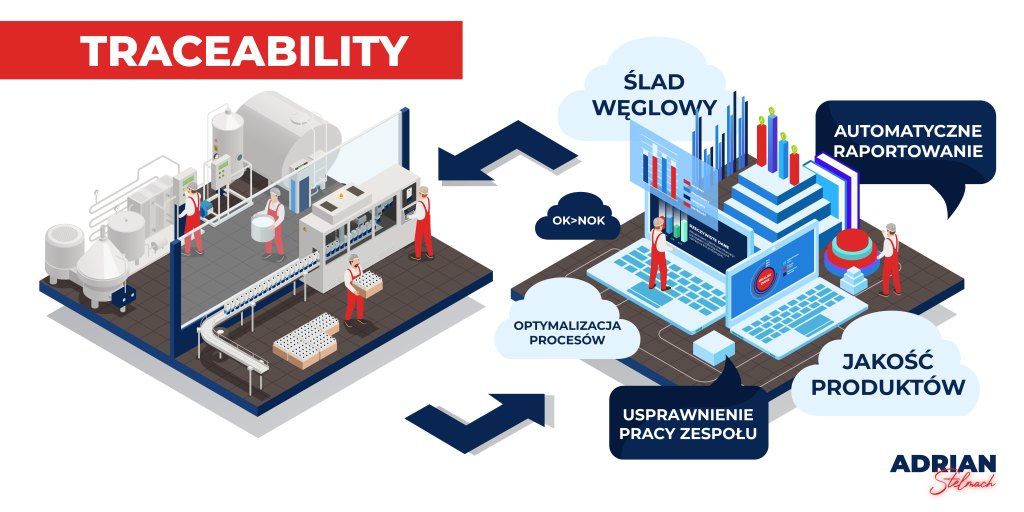
A strong food traceability system connects information from different production stages into one usable batch history.
That makes it easier to check:
which raw material lot went into a finished product
what happened during production
which parameters were recorded
where a deviation appeared
which other batches may be connected to the same issue
In day-to-day work, food traceability should support three things especially well:
reconstructing product genealogy
responding quickly to complaints and quality incidents
preparing audit records without manual searching across departments
This matters even more in food manufacturing because production is often continuous, multi-stage, and highly dependent on lot relationships.
Example: how food traceability changes the response
Let’s say a beverage producer finds a quality issue in one finished batch.
The team now needs to confirm:
which ingredient lots were used
which blending stage the batch came from
whether the same ingredient was used in other products
which filling line handled the batch
which shipments included the affected lot
If that information sits in different files, reports, and systems, the investigation slows down immediately.
With better food traceability, the team can move through the batch history faster, see related lots, and decide what actually needs to be blocked.
That changes both the speed and the cost of the response.
What better food traceability can improve
The biggest gains from food traceability often show up in daily operations, not only during a major incident.
Faster complaint handling
Your team can identify what happened and how wide the issue may be without rebuilding the batch history by hand.
Better audit readiness
Instead of searching across several departments, you have a clearer view of the product path and the records linked to it.
Fewer documentation errors
Less manual rewriting means fewer avoidable mistakes.
Better production and quality decisions
It becomes easier to connect a problem to a specific raw material lot, machine, line, operator, or process stage.
Less uncertainty during quality events
When something goes wrong, your team has data to work with instead of assumptions.
How to improve food traceability in your plant
The first question should not be which tool to buy.
Before choosing any system, define:
what needs to be traced
how detailed the traceability level needs to be
which process points matter most
what production, quality, logistics, and management need to see
where the required data comes from today
where delays, gaps, and manual transfers happen
That gives you a much better base for improving food traceability in a way that matches the real production process.
This is especially important in food plants where the process is continuous, multi-step, or specific to one site.
Choosing a food traceability system
Not every manufacturer needs the same setup.
The right food traceability system depends on your production model, data sources, batch structure, and investigation needs.
When comparing options, it helps to look at:
how raw material lots connect to semi-finished and finished goods
how quickly batch genealogy can be rebuilt
how production, quality, and logistics data are linked
how much manual work is still required
how easily the system supports audits, complaints, investigations, and product holds
If you want to explore that topic further, this is the place to link to a related page about traceability software, batch genealogy, or product traceability in manufacturing.
Why food traceability is an operational issue
The more complex the process, the less sense it makes to rebuild product history by hand.
Well-organized food traceability helps you reduce risk, act faster, and avoid blocking more product than necessary.
If your team still has to manually pull records from several places to understand one batch history, that is a strong sign the process needs to be cleaned up both operationally and systemically.
FAQ: food traceability
What is food traceability?
Food traceability is the ability to track where food came from, how it moved through production, and which finished batch it became part of.
Is food traceability required in the food industry?
Yes. Food manufacturers need to be able to identify product origin and product movement. In many cases, they also need enough internal visibility to reconstruct batch history inside the plant.
What is the difference between manual and automated food traceability?
Manual food traceability relies on spreadsheets, paper records, and disconnected files. Automated traceability connects process and business data, making batch history faster to reconstruct and less prone to error.
What problems does food traceability help solve?
It is especially useful in complaints, recalls, quality deviations, audits, and investigations involving raw materials or process issues.
What data should food traceability include?
At minimum, food traceability should include raw material lots, recipes, work orders, process parameters, semi-finished products, quality records, finished goods, and shipment data.
When should a manufacturer improve food traceability?
Usually when complaint handling takes too long, audits require manual searching, data is scattered across multiple places, or the team struggles to narrow the scope of a quality issue.
Can food traceability reduce costs?
Yes. Better food traceability can reduce unnecessary product holds, shorten investigations, improve visibility into losses, and support faster decisions.
How should a company choose a food traceability system?
Start with the process and the data. Define what needs to be traced, which decisions the system must support, and where the required records come from. Then evaluate systems against those needs.
See how product traceability can help your plant. Let’s talk.
To provide the best experiences, we use technologies like cookies to store and/or access device information. Consenting to these technologies will allow us to process data such as browsing behavior or unique IDs on this site. Not consenting or withdrawing consent, may adversely affect certain features and functions.
Functional
Always active
The technical storage or access is strictly necessary for the legitimate purpose of enabling the use of a specific service explicitly requested by the subscriber or user, or for the sole purpose of carrying out the transmission of a communication over an electronic communications network.
Preferencje
Przechowywanie lub dostęp techniczny jest niezbędny do uzasadnionego celu przechowywania preferencji, o które nie prosi subskrybent lub użytkownik.
Statistics
The technical storage or access that is used exclusively for statistical purposes.Przechowywanie techniczne lub dostęp, który jest używany wyłącznie do anonimowych celów statystycznych. Bez wezwania do sądu, dobrowolnego podporządkowania się dostawcy usług internetowych lub dodatkowych zapisów od strony trzeciej, informacje przechowywane lub pobierane wyłącznie w tym celu zwykle nie mogą być wykorzystywane do identyfikacji użytkownika.
Marketing
Przechowywanie lub dostęp techniczny jest wymagany do tworzenia profili użytkowników w celu wysyłania reklam lub śledzenia użytkownika na stronie internetowej lub na kilku stronach internetowych w podobnych celach marketingowych.