Humanoid Robots in Manufacturing: What to Check Before They Enter Your Factory
Humanoid robots on the factory floor look impressive. They walk, move parts, operate a station, and sometimes talk to people. It is easy to assume that if one looks like an operator, it can replace them.
But manufacturing is not won by appearances. It is won by process stability, cost control, uptime, safety, and line performance.
If you are a Plant Manager, Operations Director, Automation Manager, Maintenance Manager, Logistics Manager, or CapEx owner, you need clear answers before a humanoid robot enters your plant:
Will a humanoid robot solve your actual problem?
What will the full implementation cost?
Do you have the production data needed to make that decision?
Before you buy a robot, check where you are losing time and money. That is why any serious discussion about humanoid robots in manufacturing should start earlier: with production monitoring, automatic production data collection, and connected data from machines, operators, and business systems.
What are humanoid robots in manufacturing?
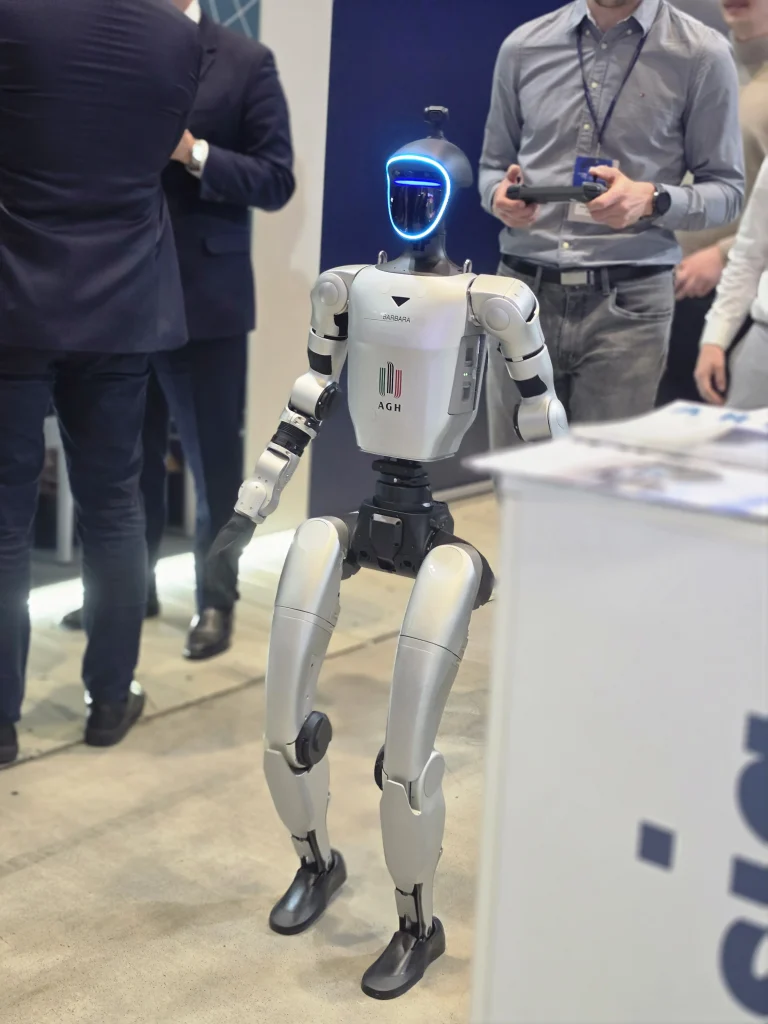
A humanoid robot is built to resemble the human body and movement. It usually has a torso, arms, manipulators, legs, cameras, sensors, communication modules, and AI-based software.
Its advantage is not speed. In many cases, a traditional industrial robot will still be faster.
The real advantage is that a humanoid robot can work in environments designed for people.
That means it may be able to enter a workstation previously operated by a person, without building a separate robotic cell, redesigning the entire line, or rebuilding the plant floor from scratch.
A humanoid robot may be a fit when:
you struggle to staff repetitive jobs,
the workstation requires human-like movements,
the process changes often,
full automation would cost too much,
a traditional robot would be too rigid for the task.
Interest in humanoid robots is growing quickly. Goldman Sachs Research projected the humanoid robot market could reach $38 billion by 2035, with estimated shipments of 1.4 million units by that year. That does not mean every factory should buy one now. It means manufacturers should start asking better questions.
Humanoid robot use cases in production
The most natural place for humanoid robots is a workstation currently handled by people, but not worth automating with a full robotic cell.
Common use cases include:
moving components,
simple assembly,
machine tending,
feeding parts into a workstation,
checking whether parts are present,
kitting and order picking,
work at variable stations.
BMW is a useful example. In 2024, BMW tested Figure 02 humanoid robots at its Spartanburg plant in South Carolina. The robot inserted sheet metal parts into fixtures that later became part of the vehicle chassis. BMW also made it clear at the time that there were no Figure AI robots permanently deployed at the plant and no fixed timetable for full rollout.
The next step shows where the market is heading. BMW later reported that a Spartanburg humanoid pilot supported production of more than 30,000 BMW X3 vehicles over ten months, with the robot working ten-hour shifts Monday through Friday. BMW also started a humanoid robotics pilot at its Leipzig plant in Germany.
That is the right way to think about humanoid robots: not as a full-line replacement, but as one measurable task that can be tested, compared, and improved.
Humanoid robots and workforce automation
Will humanoid robots replace people?
In some tasks, yes. Especially tasks that are repetitive, physically demanding, hard to staff, or ergonomically poor.
The more realistic scenario for the next few years is simpler: humanoid robots will support people where labor is hard to find or where traditional automation is too rigid.
Factories will still need people who can:
understand the process,
react to unusual situations,
supervise quality,
analyze data,
teach robots new tasks,
make decisions during failures.
The operator’s role will change. There will be less manual carrying and repetitive movement, and more supervision, checking, response, and work with production systems.
Humanoid robot or traditional robotic cell?
Not every automation project needs a humanoid robot. Sometimes a traditional industrial robot will be faster, cheaper, and easier to control.
Criterion
Humanoid robot
Traditional robotic cell
Work environment
Best for stations designed for people
Often requires process redesign
Flexibility
High for changing tasks
Lower when tasks change often
Speed
Not always the main benefit
Usually high
Best fit
Variable, human-centered stations
Stable, high-volume processes
Cost
Depends on integration, service, software, and downtime
Depends on cell design, tooling, and guarding
If the process is stable and repeatable, check traditional robot automation first.
If the process changes often and the workstation was built around a person, a humanoid robot may deserve a pilot.
Cost of implementing humanoid robots
A future target price for humanoid robots is often discussed in the $30,000 to $50,000 range. On paper, that looks close to the annual cost of a production worker.
For comparison, the U.S. Bureau of Labor Statistics reported a $45,960 median annual wage for production occupations in May 2024. The National Association of Manufacturers reported that U.S. manufacturing employees earned $106,691 on average in 2024, including pay and benefits.
machine monitoring that shows downtime, statuses, and deviations,
PLC, SCADA, and ERP integration so the plant sees the process in one place,
a Production Portal for analyzing orders, quality, process parameters, and material availability.
Before you buy a robot, you can check where automation will actually help.
Examples:
If the real problem is manual reporting, automate data collection first.
If material shortages stop the line, improve internal logistics first.
If cycle time changes from shift to shift, test whether a robot can stabilize one specific task.
Only then does the humanoid robot decision rest on numbers, not a demo video.
When a humanoid robot will not work
Do not start with a humanoid robot if:
you do not have process data,
you do not know the causes of downtime,
operators report production manually after the shift,
the real problem is planning, not labor shortage,
the process can be automated more simply with a traditional robot,
you do not have a service and failure response plan.
A robot can help. It cannot replace order in data, planning, and material flow.
What to do before buying a humanoid robot
The safest path is simple:
Choose one workstation with a staffing problem or a high level of repetitive work.
Collect data on cycle time, downtime, errors, quality, and cost.
Compare three options: human operator, traditional automation, humanoid robot.
Check network, power supply, safety, MES, ERP, and SCADA integration.
Plan fallback scenarios.
Run a pilot on one task.
Measure results after implementation.
If the robot proves itself, you can think about scale.
If it does not, you still gain a clearer view of the process.
What comes next?
If humanoid robots are already being discussed in your company, do not start with the question: “Which robot should we buy?”
Start with better questions:
Which workstation really needs to change?
What does the current way of working cost?
Where do we lack people?
Where does manual reporting distort the data?
How quickly do we see downtime and deviations?
Are our production systems connected?
Only then should you move to humanoid robots.
Before you discuss a purchase, check the data layer first: production monitoring, MES, automatic production data collection, machine data, and integration with ERP, SCADA, and PLC systems.
That is the work that makes a robot pilot easier to defend, easier to measure, and safer to scale.
Humanoid robots: want to learn more? Listen to the latest episode of Digitalizuj.pl
If you’d rather listen about humanoid robots and learn even more about the topic, I invite you to check out the latest episode of the Digitalizuj.pl podcast, where I cover it in detail.
Humanoid robots make the most sense where the workstation is designed for people, the process changes often, workers are hard to find, and traditional automation would be too expensive or too rigid.
Are humanoid robots cheaper than workers?
The robot’s hardware price may look similar to one year of labor cost, but the full cost includes integration, service, charging, safety, software, data infrastructure, downtime planning, and human supervision.
How should a factory prepare for humanoid robots?
Start with data. Organize production data, downtime, machine statuses, quality, orders, and material flow. Without that, it is hard to know whether the robot will produce a real return.
Want to find out if your manufacturing plant is ready for humanoid robots? Let's talk!
To provide the best experiences, we use technologies like cookies to store and/or access device information. Consenting to these technologies will allow us to process data such as browsing behavior or unique IDs on this site. Not consenting or withdrawing consent, may adversely affect certain features and functions.
Functional
Always active
The technical storage or access is strictly necessary for the legitimate purpose of enabling the use of a specific service explicitly requested by the subscriber or user, or for the sole purpose of carrying out the transmission of a communication over an electronic communications network.
Preferencje
Przechowywanie lub dostęp techniczny jest niezbędny do uzasadnionego celu przechowywania preferencji, o które nie prosi subskrybent lub użytkownik.
Statistics
The technical storage or access that is used exclusively for statistical purposes.Przechowywanie techniczne lub dostęp, który jest używany wyłącznie do anonimowych celów statystycznych. Bez wezwania do sądu, dobrowolnego podporządkowania się dostawcy usług internetowych lub dodatkowych zapisów od strony trzeciej, informacje przechowywane lub pobierane wyłącznie w tym celu zwykle nie mogą być wykorzystywane do identyfikacji użytkownika.
Marketing
Przechowywanie lub dostęp techniczny jest wymagany do tworzenia profili użytkowników w celu wysyłania reklam lub śledzenia użytkownika na stronie internetowej lub na kilku stronach internetowych w podobnych celach marketingowych.